
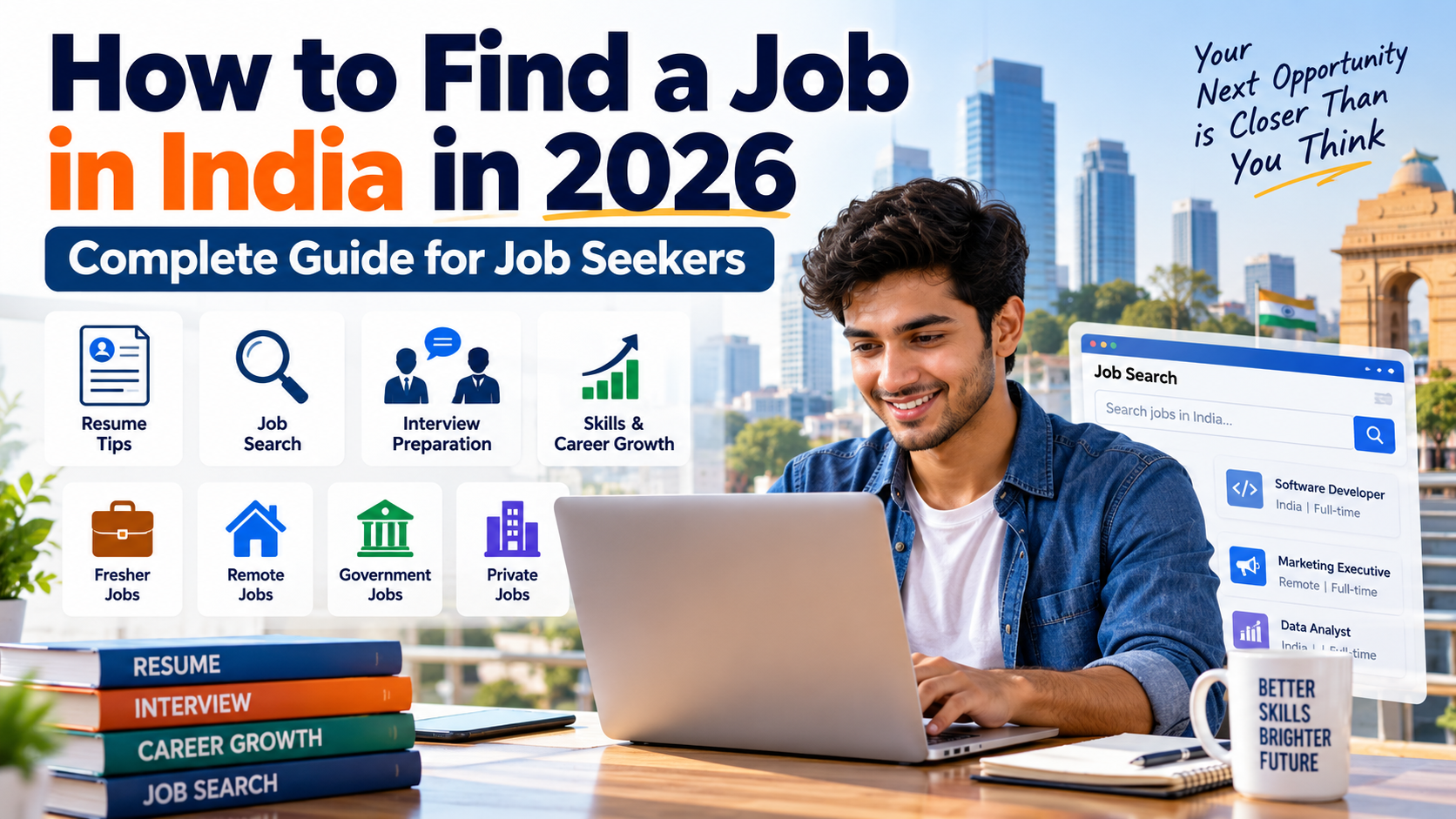
How to Find a Job in India in 2026: Complete Guide for Job Seekers
Finding a job in India can feel difficult, especially when hundreds of candidates are applying for the same position. Whether you are a fresher looking for your first job, an experienced professional planning a career change, or someone searching for a remote opportunity, having the right strategy can make your job search much easier.
In this guide, we will explain how to find the right job in India in 2026, where to search, how to prepare your resume, and how to improve your chances of getting hired.
1. Decide What Kind of Job You Want
Before you start applying, first decide what type of job you are looking for.You can search for:
- Full-time jobs
- Part-time jobs
- Remote jobs
- Work-from-home jobs
- Internship opportunities
- Government jobs
- Private jobs
- Freelance opportunities
Also consider your preferred location, salary, experience level, education, and skills.
For example, a software developer may search for:
- Full Stack Developer jobs
- PHP Developer jobs
- Laravel Developer jobs
- React Developer jobs
- Remote Developer jobs
Having a clear target will help you avoid wasting time applying for unsuitable positions.
2. Identify Your Skills
Your skills are one of the most important factors employers consider when hiring.
Make a list of your technical and professional skills.
For example:
Technical skills
- PHP
- Laravel
- JavaScript
- React
- Node.js
- Python
- MySQL
- AWS
- WordPress
Professional skills
- Communication
- Teamwork
- Problem-solving
- Time management
- Leadership
- Customer service
Compare your skills with the requirements mentioned in job descriptions. This will help you identify which skills you already have and which ones you need to improve.
3. Create an ATS-Friendly Resume
Your resume is often the first thing a recruiter sees.
A good resume should clearly show:
- Your name and contact details
- Professional summary
- Skills
- Work experience
- Education
- Projects
- Certifications
- Achievements
- Keep your resume simple and easy to read.
Many companies use Applicant Tracking Systems (ATS) to filter applications. Using relevant keywords from the job description can help your resume match the position more effectively.
- Avoid these common resume mistakes:
- Using too many graphics
- Adding unnecessary personal information
- Writing a very long resume
- Using spelling or grammar mistakes
- Listing skills you don't actually have
- Sending the same resume for every job
4. Search for Jobs Online
Online job portals are one of the easiest ways to find employment opportunities.
Instead of searching for only "jobs", use specific searches such as:
"PHP Developer jobs in Delhi"
"Remote jobs for freshers in India"
"Software Developer jobs in Noida"
"Work from home jobs in India"
The more specific your search is, the easier it becomes to find relevant opportunities.
5. Apply for Jobs That Match Your Profile
You don't need to apply for every job you find.
- Before applying, check:
- Required experience
- Required skills
- Job location
- Salary range
- Job responsibilities
- Educational requirements
- Employment type
If your profile matches most of the requirements, apply.
Quality applications are generally more useful than sending hundreds of random applications.
6. Customize Your Resume for Each Job
One of the biggest mistakes job seekers make is using exactly the same resume for every position.
For example, if a company is looking for a Laravel Developer, make sure your Laravel experience, projects, and relevant skills are clearly visible.
If another company is hiring a React Developer, highlight your React experience instead.
A customized resume can make it easier for recruiters to understand why you are suitable for the position.
7. Prepare for Job Interviews
Getting an interview means your application has attracted the employer's attention. Now you need to prepare for the next step.
Common interview questions include:
Tell me about yourself.
Why do you want to join our company?
What are your strengths?
What are your weaknesses?
Why should we hire you?
What are your salary expectations?
Where do you see yourself in the next five years?
For technical positions, prepare for questions related to your programming languages, frameworks, databases, projects, and previous work experience.
8. Improve Your Communication Skills
Technical knowledge is important, but communication also plays a major role in many jobs.
Practice:
- Speaking clearly
- Explaining your experience
- Answering interview questions
- Writing professional emails
- Communicating with clients and colleagues
You don't need complicated English. Clear and confident communication is more important.
9. Keep Learning New Skills
The job market changes continuously.
A skill that is highly demanded today may become less valuable in the future. Regular learning can help you remain competitive.
You can improve your skills through:
- Online courses
- Practical projects
- Certifications
- Internships
- Workshops
- YouTube tutorials
- Open-source projects
For technical careers, don't just learn theory. Build real projects and add them to your portfolio.
10. Build a Professional Online Presence
Your online presence can also influence your job search.
Keep your professional profiles updated with:
- Current job title
- Skills
- Experience
- Projects
- Education
- Certifications
- Portfolio
For developers and designers, having a portfolio website can be particularly useful because employers can see your actual work.
11. Consider Remote Jobs
Remote work has become an important option for many professionals.
If you are searching for remote jobs, look for positions that clearly mention:
Remote
Work from home
Remote-first
Hybrid
Work from anywhere
However, always verify the company and job posting before sharing personal information or paying any fees.
Never pay money simply to get a job.
12. Be Careful About Fake Job Offers
Job seekers should be careful when applying online.
Warning signs of a potentially fraudulent job include:
Asking for money before joining
Asking for your banking password or OTP
Promising an unusually high salary for little work
No proper company information
Pressure to make an immediate payment
Communication only through suspicious accounts
Always research the employer before accepting an offer.
13. Don't Give Up After Rejection
Job rejection is a normal part of the hiring process.
You may not get selected even when you have the required skills. Instead of giving up, use every rejection as an opportunity to improve.
Ask yourself:
Was my resume relevant?
Did I prepare enough for the interview?
Do I need better technical skills?
Was my communication clear?
Was the job actually suitable for me?
Then make improvements and continue applying.
14. Create a Daily Job Search Routine
A consistent routine can make your job search more effective.
For example:
Morning
Check new job listings
Apply for relevant positions
Afternoon
Learn or improve one skill
Work on your portfolio
Evening
Practice interview questions
Connect with recruiters and professionals
Even spending a few focused hours every day can produce better results than randomly applying whenever you have time.
15. Choose the Right Job, Not Just Any Job
Getting a job is important, but choosing the right opportunity is equally important.
Consider:
Salary
Career growth
Company culture
Learning opportunities
Job stability
Work-life balance
Location or remote flexibility
Responsibilities
A job should support your long-term career goals rather than only provide a short-term salary.
Final Thoughts
Finding a job in India in 2026 requires more than simply sending resumes to companies. You need a clear career goal, a strong resume, relevant skills, interview preparation, and a consistent job-search strategy.
Start by identifying the type of job you want. Improve your skills, create an ATS-friendly resume, search for relevant opportunities, and prepare carefully for interviews.
Most importantly, stay consistent. Your first application may not lead to an offer, but the right preparation can bring you closer to the right opportunity.
Keep learning. Keep applying. Keep improving. Your next career opportunity could be just one application away.