
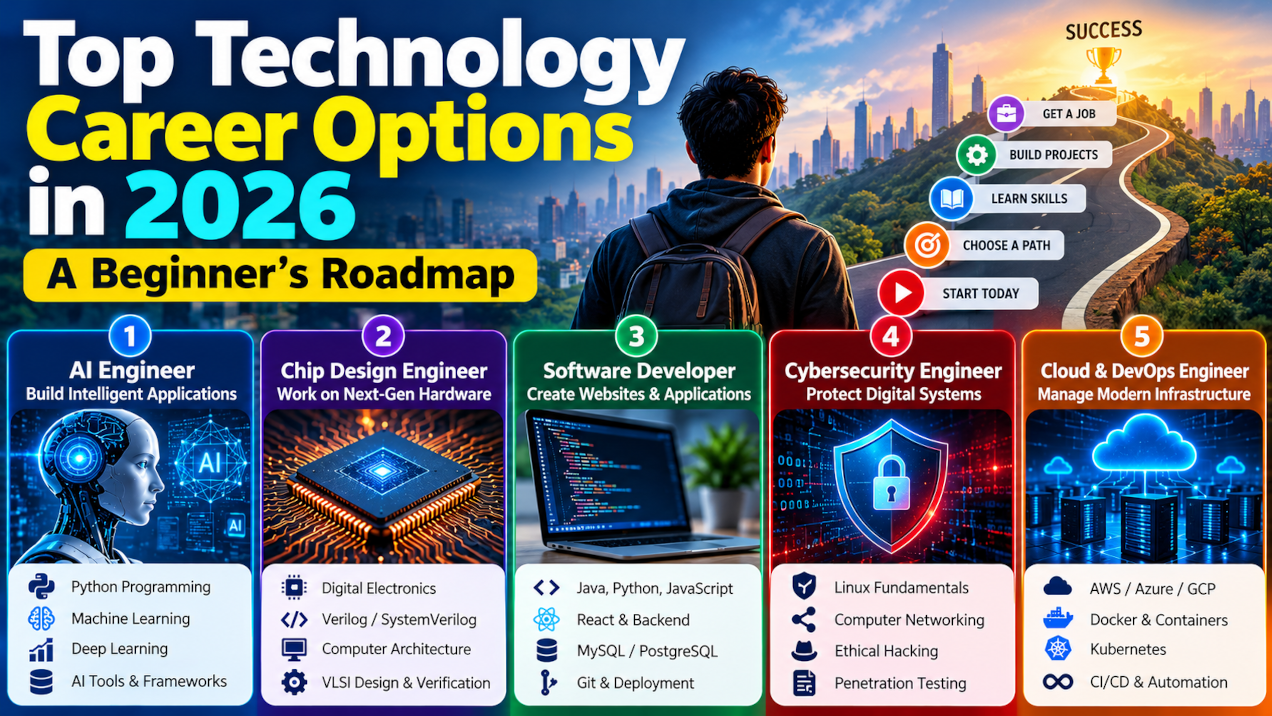
How to Build a Successful Technology Career in 2026: A Beginner's Roadmap
Technology is transforming the way people work, communicate, and solve problems. From artificial intelligence to semiconductor manufacturing, new technologies are creating exciting career opportunities for students, fresh graduates, and professionals looking to upgrade their skills.
But with so many career choices available, one important question remains: Which technology career should you choose, and how can you prepare for it?
In this guide, we explore five technology career paths and practical steps to help you get started.
1. AI Engineer: Build Intelligent Applications
Artificial intelligence is helping businesses automate tasks, analyze information, and develop smarter products.
AI engineers work on applications such as chatbots, recommendation systems, image recognition, and intelligent assistants.
Skills to learn:
Python programming
Machine learning fundamentals
Data structures and mathematics
AI frameworks and tools
Beginner project: Build a simple chatbot or an application that classifies images.
AI is a good option for people who enjoy programming, mathematics, and solving complex problems.
2. Chip Design Engineer: Work on the Hardware Behind Technology
Every smartphone, computer, and AI accelerator depends on semiconductor chips.
Chip design engineers help develop the electronic circuits that power modern devices. This field combines computer engineering, electronics, and specialized hardware design.
Skills to learn:
Digital electronics
Verilog and SystemVerilog
Computer architecture
VLSI design and verification
Beginner project: Design a basic digital circuit, such as a counter or calculator, using Verilog and simulate it with an appropriate HDL tool.
This career is particularly suitable for people interested in electronics and understanding how computers work at the hardware level.
3. Software Developer: Create Websites and Applications
Software development remains a practical career path for people who want to build products and solve business problems.
Developers create websites, mobile applications, APIs, and enterprise software.
Skills to learn:
Java, Python, or JavaScript
React or another frontend framework
Backend development
SQL and database management
Git and deployment
Beginner project: Create a job portal, inventory application, or online learning website.
A portfolio of working applications can help demonstrate your skills to potential employers.
4. Cybersecurity Engineer: Protect Digital Systems
As businesses depend increasingly on digital systems, protecting information and infrastructure is an important responsibility.
Cybersecurity professionals investigate security weaknesses, monitor threats, and help prevent unauthorized access.
Skills to learn:
Linux fundamentals
Computer networking
Web application security
Security monitoring
Ethical penetration testing
Beginner project: Set up a private cybersecurity lab and practice identifying vulnerabilities in intentionally vulnerable applications.
Always conduct security testing only on systems you own or have explicit permission to test.
5. Cloud and DevOps Engineer: Manage Modern Infrastructure
Cloud and DevOps engineers help organizations deploy applications, manage servers, and automate software delivery.
They work with cloud infrastructure, containers, monitoring systems, and deployment pipelines.
Skills to learn:
Linux and networking
Docker
Cloud platforms such as AWS, Azure, or Google Cloud
CI/CD automation
Kubernetes fundamentals
Beginner project: Deploy a web application using Docker and create an automated deployment pipeline.
A Practical 6-Month Learning Plan
You do not need to master every technology at once. Start with a focused learning plan.
| Month | Learning goal |
|---|---|
| 1 | Learn programming fundamentals and Linux |
| 2 | Choose one career path and study its core concepts |
| 3 | Complete a beginner-level project |
| 4 | Build a more advanced practical project |
| 5 | Create a portfolio and improve your technical knowledge |
| 6 | Prepare your resume, apply for internships, and practice interviews |
This is a suggested learning schedule, not a guarantee of employment. The time required depends on your starting knowledge and the complexity of your chosen field.
Important Tips for Beginners
Choose one primary skill. Learning multiple fields simultaneously can make it difficult to develop practical expertise.
Build projects while learning. Practical experience helps you understand concepts and demonstrate your abilities.
Learn the fundamentals. Programming, mathematics, electronics, networking, and problem-solving remain valuable even as tools change.
Keep your portfolio updated. Document your projects, explain the technologies used, and show what you learned.
Conclusion
A successful technology career begins with curiosity, consistent learning, and practical experience.
Whether you choose AI engineering, chip design, software development, cybersecurity, or cloud computing, focus on developing strong fundamentals and building projects that demonstrate your skills.
The best career choice is not necessarily the most popular one. It is the one that matches your interests, strengths, and long-term goals.