
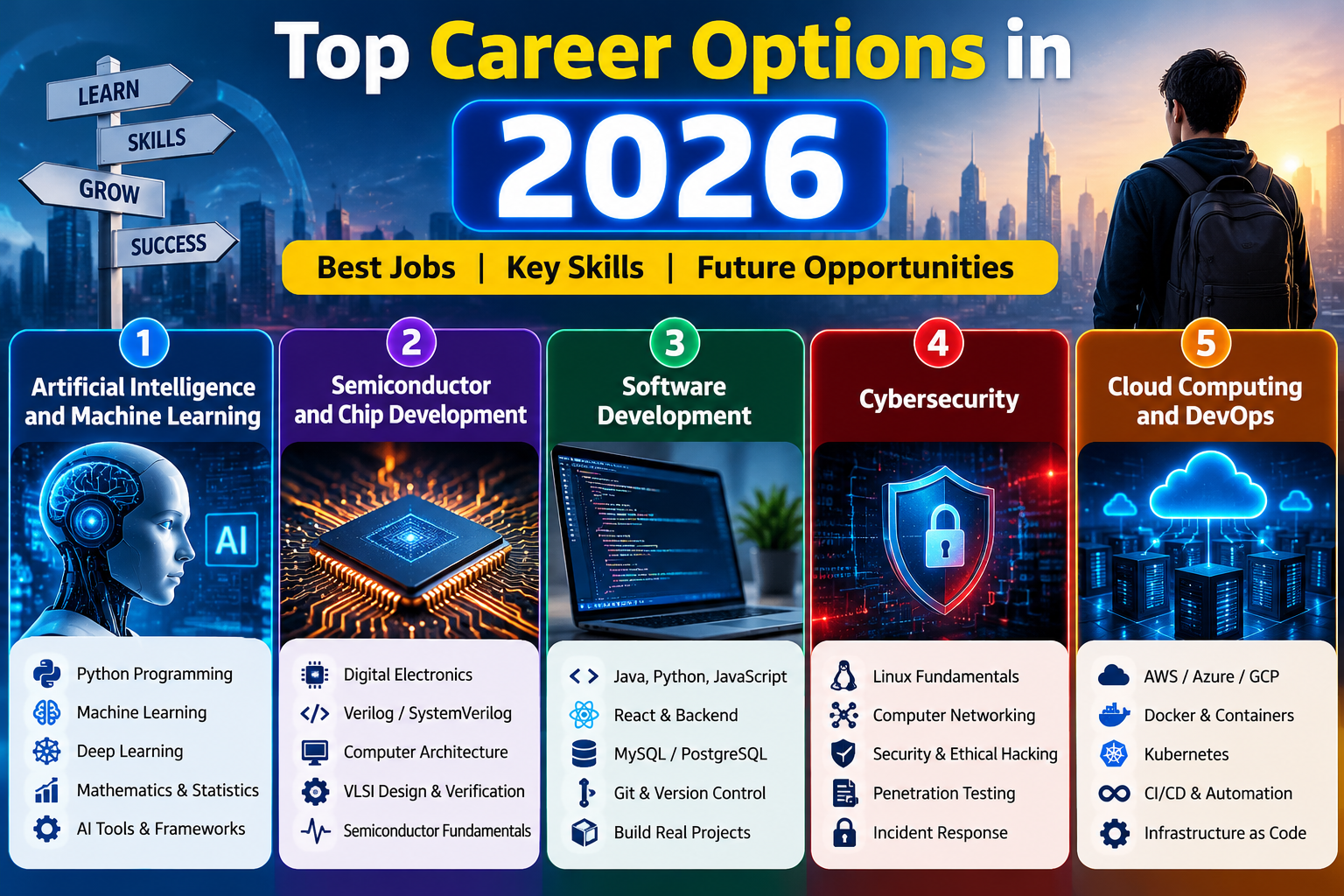
Top Career Options in 2026: Best Jobs, Skills, and Future Opportunities
The world of work is changing rapidly. Artificial intelligence, semiconductor technology, cloud computing, cybersecurity, and digital businesses are creating new career opportunities.
Choosing the right career in 2026 is not just about finding a high-paying job. It is about developing skills that will remain valuable in the future.
In this blog, we explore some of the best career options in 2026, the skills required, and how beginners can get started.
1. Artificial Intelligence and Machine Learning
Artificial intelligence is becoming an important part of industries such as healthcare, finance, education, manufacturing, and software development.
AI engineers develop intelligent applications, automation systems, chatbots, and machine learning models.
Skills required:
Python programming
Mathematics and statistics
Machine learning
Deep learning
AI tools and frameworks
How to start: Learn Python, understand basic mathematics, and build small AI projects such as a chatbot or image classification application.
2. Semiconductor and Chip Development
Semiconductor technology is essential for smartphones, computers, automobiles, communication systems, and artificial intelligence hardware.
Chip development is a promising career for people interested in electronics and computer hardware.
Popular career roles include:
VLSI design engineer
RTL design engineer
Verification engineer
Semiconductor process engineer
Embedded systems engineer
Skills required: Digital electronics, Verilog or SystemVerilog, computer architecture, and semiconductor fundamentals.
How to start: Study digital logic, learn Verilog, and use tools such as Verilator, GTKWave, and open-source chip design platforms.
3. Software Development
Software developers create websites, mobile applications, business systems, and digital services.
This career offers opportunities in startups, technology companies, and freelance development.
Skills required:
Java, Python, or JavaScript
React and backend development
Databases such as MySQL or PostgreSQL
Git and software development practices
How to start: Build practical projects, create a portfolio, and learn how to deploy applications online.
4. Cybersecurity
Cybersecurity professionals help organizations protect their networks, applications, systems, and data from cyberattacks.
Career opportunities include security analyst, penetration tester, security engineer, and incident response specialist.
Skills required: Linux, computer networking, security fundamentals, scripting, and ethical hacking techniques.
How to start: Learn networking and Linux, practice in legal cybersecurity labs, and develop a strong understanding of system security.
5. Cloud Computing and DevOps
Cloud computing allows companies to operate applications and infrastructure using services such as AWS, Microsoft Azure, and Google Cloud.
DevOps engineers automate software deployment, manage infrastructure, and improve application reliability.
Skills required: Docker, Linux, cloud platforms, CI/CD, Kubernetes, and infrastructure automation.
How to start: Deploy a simple web application, containerize it with Docker, and learn how to automate its deployment.
How to Choose the Right Career
Before selecting a career, consider these three factors:
Interest: Choose a field that you enjoy learning about.
Skills: Identify the skills you can develop through practice.
Opportunities: Research job openings, internships, and the qualifications employers require.
You do not need to learn every technology at once. Start with one field, build projects, and gradually develop advanced skills.
Conclusion
The best career in 2026 is one that matches your interests, abilities, and long-term goals. AI, semiconductor development, software engineering, cybersecurity, and cloud computing all offer opportunities for people willing to learn and practice consistently.
Start with the fundamentals, work on real projects, and keep improving your skills. Practical experience and continuous learning can help you build a successful career in the technology industry.